


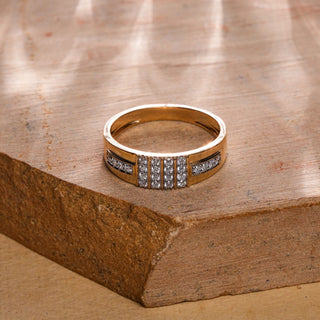


Lab-Grown Diamond Wedding Bands
Reia's wedding band collection features diamond-set designs in BIS-hallmarked yellow, white, and rose gold. The collection includes full eternity, half-set, curved, chevron, and low-profile designs, with lab-grown diamonds selected to Reia's EF colour and VVS clarity house standard. In-stock pieces typically ship within five working days, while made-to-order designs follow their applicable production timeline.
BIS-hallmarked gold · EF colour, VVS clarity · Certificate with every piece · Free resizing on most designs · Cash on Delivery · Try them on in Bengaluru, Coimbatore & Guwahati
What's in Reia's Wedding Diamond Band Collection
A wedding band is a ring exchanged at a marriage ceremony and worn afterwards as a continuing sign of that marriage. It's built around the band itself rather than a raised centre stone, which is why it sits low, wears well, and disappears into daily life the way an engagement ring never quite does.
Every band here is diamond-set. There are no plain metal bands in this collection, and no platinum. What changes from design to design is how much of the band carries diamonds, how those stones are held, and how high the ring sits on your finger.
Four design families:
-
Continuous-diamond bands: stones running the full circumference, in shared-prong or channel settings
-
Partial-set bands: diamonds across the top half or top third, polished gold behind
-
Shaped bands: chevron, V and bypass profiles that curve rather than run straight
-
Structured bands: multi-row, lattice and split-shank designs with more presence
Diamonds are mostly round brilliant, with marquise, oval, emerald, pear and princess cuts appearing where the shape carries the pattern. Browse the wider rings collection if you want to see how these sit alongside everything else Reia makes.
Wedding Band or Engagement Ring?
An engagement ring marks the proposal. It's usually built around a prominent centre diamond, and it sits higher because that stone has to be held above the band.
A wedding band marks the marriage. It's exchanged at the ceremony and is normally flatter, lower and more continuous.
That's the tradition, not a rule, and plenty of people set it aside for good reasons:
-
Wearing a band alone, with no engagement ring at all
-
Stacking both on the same finger
-
Choosing two bands that share a metal but nothing else
-
Buying a diamond band for an anniversary and wearing all three
-
Wearing a band simply as an everyday ring, with no ceremony attached
If this is the only ring you'll wear, a half-set or full eternity design usually earns its place better than a very slim single-row band; it reads as jewellery every day, not just on the day. Reia's guide to how the two rings differ goes deeper.
Choosing a Band by How You'll Wear It
Style names matter less than three questions: how much diamond, how high it sits, and whether it runs straight or curves.
Full eternity bands
Diamonds all the way round. It looks identical from every angle and never needs straightening on your finger. One trade-off you should know before you buy: because stones run the full circumference, a full eternity band generally cannot be resized; there's no plain metal to cut into. Get the size right first time, and think about how much your fingers swell in summer or after a long day.
Half and partial-set bands
Diamonds across the top half or third, polished gold behind. This is the most practical everyday architecture in the collection. It resizes, it sits comfortably against your other fingers, and you get the same visible sparkle for meaningfully less than a full eternity equivalent because you're not paying for stones nobody sees.
Curved and chevron bands
Instead of a straight circle, these dip into a V, curve, or cross over themselves. Two good reasons to choose one: they nest against an engagement ring with a pointed or elongated centre stone where a straight band would leave a gap, and they look deliberate rather than unfinished when worn alone. Reia's chevron and curve designs are built for both.
Wide and multi-row bands
Parallel rows, lattice patterns, or one broad diamond-set surface. These carry the most diamond weight here, and they have real presence. Two practical notes: a wide band visually shortens the finger, and it will crowd an engagement ring on the same hand. Plenty of people wear these on the right hand for exactly that reason.
Flat, low-profile bands
The men's designs sit closest to the finger flat or gently domed, with stones flush-set, channel-set or arranged in geometric blocks rather than raised. Polished and matte finishes both appear. Low profile matters more than it sounds: a ring that sits flat survives keyboards, gym bars, gloves and steering wheels far better than one with raised settings. It's worth considering whichever section you're browsing.
Wedding bands can be chosen by width, profile, diamond coverage, and overall proportion rather than by gender category. Choose the design that suits how you want to wear it. The differences that actually matter are width, coverage and profile height, and any design can be made in your size. If you like something filed under the other heading, it's still yours.
Pairing a Wedding Band with an Engagement Ring
Worth saying plainly: not every band pairs well with every engagement ring. Not every wedding band will sit comfortably or proportionately with every engagement-ring setting.
Four things decide it:
Metal: Matching is the safe choice and reads as intentional. Mixing can look excellent: a rose gold band under a white gold solitaire, but it has to look like a decision rather than an accident. If you're unsure, match.
The gap: A straight band sits flush against a low, flat-based setting. Against a high-set solitaire, a pointed pear or marquise, or a ring with a decorative under-gallery, it leaves a visible wedge of space. That gap is one of the main fit considerations when pairing a straight band with an engagement ring. A curved or chevron band is designed to close it.
Proportion: Look at the two shanks side by side, not the two rings as objects. A delicate 1.6mm engagement ring shank will be overwhelmed by a 4mm multi-row band.
Coverage: A heavily pavé-set engagement ring next to a full eternity band can read as busy, especially on a smaller hand. A polished or half-set band gives the centre stone room to do its job.
The most reliable approach is to bring the engagement ring and try bands against it. If you're buying online, a Reia advisor will do exactly that on a live video call before you commit. You can also compare proportions directly against the engagement ring collection or the solitaire designs, and Reia's styling guide for matching bands covers the aesthetics in more depth.
How to Choose the Right Wedding Band
Which gold colour?
Three, all BIS-hallmarked: yellow, white and rose. Platinum isn't part of Reia's range.
-
Yellow gold is the traditional Indian choice, warm on most skin tones, easiest to match to gold you already wear.
-
White gold creates a low-contrast look with near-colourless diamonds, which can give the setting a bright, cohesive appearance. It's rhodium-plated, and that plating is refreshed periodically as part of normal care.
-
Rose gold has a warmer appearance and offers an alternative to traditional yellow or white gold.
Already have the engagement ring? Match it. Buying both together? Choose the metal for the engagement ring first; the centre stone is what it has to flatter.
How much diamond coverage?
-
Full eternity: sparkle from every angle; usually can't be resized; highest price for the same design
-
Half eternity: the same visible sparkle when worn, resizable, better value
-
Partial or single-row: quiet, slim, easiest to stack, lowest price
-
Multi-row or wide: most presence; best worn alone or on the other hand
Rule of thumb: if it'll sit next to an engagement ring, less coverage usually looks better. If it's flying solo, more coverage earns its keep. Reia's eternity bands and everyday bands are worth a look alongside this collection.
What width suits your hand?
Narrow bands suit slimmer fingers and stack cleanly. Broader bands need a longer or wider finger to sit in proportion. A useful proxy here is gross weight: the slimmest designs sit around 1g, the widest structured bands approach 7g a real difference after twelve hours on your hand.
If you're unsure about width, compare the band against your engagement ring and consider both finger proportion and how much space you want the two rings to occupy together.
Should couples match?
No requirement, and identical is only one of three good answers:
-
Identical: the same design in two sizes. Cohesive, and the simplest decision to make.
-
Complementary: shared metal and setting style, different widths and coverage. The most common choice now, and usually the better-looking one, because two hands are rarely alike.
-
Independent: two designs chosen separately. Perfectly valid.
Reia doesn't currently sell pre-paired his-and-hers sets, so a matched pair is assembled from two individual designs or built to match through custom design.
Getting the size right
Size matters more here than on almost any other ring, because you'll wear it continuously.
Two rules:
-
Measure at the end of the day when your fingers are largest, and
-
Measure the specific finger the ring will live on.
Many Reia rings can be resized, subject to the design. Full eternity bands generally cannot be resized because diamonds run around the entire circumference. Confirm the applicable resizing options and sizing before ordering. For made-to-order pieces, sizing is confirmed with you before anything is crafted. The ring sizing guide walks through measuring at home.
Why Lab-Grown Diamonds for a Ring You Never Take Off
A lab-grown diamond is a diamond made in a controlled setting rather than recovered from the ground. Same material, carbon in the same crystal structure, the same hardness of 10 on the Mohs scale, the same optical and physical properties, and they can be graded by the same independent gemological laboratories using established diamond-grading standards. It is not a simulant. Cubic zirconia and moissanite are different materials entirely.
Three things follow for a wedding band specifically:
Durability is the whole point: A wedding band takes more daily contact than any other ring you'll own. Diamond hardness is what lets it survive that, and lab-grown diamonds have exactly the same hardness as mined ones.
Price behaves differently: Lab-grown diamonds generally cost considerably less than mined stones of comparable size and grade, which is what puts continuous-diamond designs like full eternity bands within reach at prices where a mined equivalent wouldn't be. That's a market observation rather than a guarantee; pricing moves with size, grade, and supplier, and lab-grown prices have shifted a great deal in recent years.
Consistency is easier to achieve: A full eternity band needs many stones that match each other. Because an eternity band contains many individual diamonds, consistency in colour, clarity, shape, and size can have a significant effect on how uniform the finished band looks. , which is part of why Reia can hold the entire collection to EF colour and VVS clarity.
On the environmental question, some honesty is due. Lab-grown production avoids the land disturbance associated with mining, but it's energy-intensive, and the real footprint depends heavily on the energy source powering the growing facility. Nobody in this industry can credibly claim zero impact, and Reia doesn't. A lab-grown diamond's laboratory origin can be documented through appropriate certification and disclosure. Its environmental footprint still depends on factors including how the growing facility is powered and operated.
Reading Diamond Quality in a Band
The four Cs work differently in a band, because you're looking at many small stones rather than one large one.
|
What matters in a wedding band |
|
|
Cut |
The most important of the four here. In small stones, cut decides whether a row reads as a continuous line of light or as dull dots. Consistency across every stone matters as much as any single grade. |
|
Colour |
Reia's standard is EF, the near-colourless top of the scale. In white gold it keeps the row visually clean; in yellow gold it stops the stones picking up a warm cast. |
|
Clarity |
Reia's standard is VVS. At the sizes used in a band, VVS inclusions are invisible without magnification. |
|
Carat |
In a band, this is total weight spread across many stones, not one stone's size. Two bands of identical total weight can look completely different depending on arrangement. |
On certification: every Reia piece ships with its jewellery certificate, and every gold setting is BIS-hallmarked for purity. Diamonds of one carat and above carry an IGI report. Smaller accent stones in pavé and channel settings aren't individually certified; that's standard across fine jewellery, and it's why the house colour and clarity standard matters as much as it does. Reia's explainer on what certification actually covers is worth five minutes if you're comparing brands.
For the shape, round brilliant dominates because it returns the most light for the size. Other shapes appear where the cut defines the design.
Price is also an important part of the decision: Diamonds are priced at a flat ₹35,000 per carat, with pricing scaling linearly. That means a 0.50-carat diamond is ₹17,500, a 1.0-carat diamond is ₹35,000, and a 2.0-carat diamond is ₹70,000. There are no price jumps at round-number weights and no variable per-stone diamond pricing.
Custom and Engraved Wedding Bands
Reia offers customisation across selected design, metal, diamond, setting, width, and finish specifications. Custom orders are subject to Reia's approval before production.
What you can specify:
-
Gold colour: yellow, white, or rose
-
Diamond shape and total carat weight
-
Setting style: pavé, channel, shared-prong, flush
-
Band width, profile, and finish
-
Coverage: full, half, partial, or a pattern of your own
-
A pair of bands designed to relate to each other
-
A band shaped to sit against a specific engagement ring
-
Engraving and personalisation
How it runs: Share a reference, photograph, sketch, or other design inspiration with Reia's team. For approved custom designs, the team can discuss the design direction and pricing, create a 3D visual for your review, and, where applicable, provide a wax model to help you assess the design and fit before production. Nothing is made until you've approved the design and confirmed the size, and you are provided with an expected delivery date before you place the order.
One thing to know: engraved and personalised pieces sit outside the standard 15-day return window, so it's worth being certain about wording and placement before you sign off.
Book a customisation appointment or start a design consultation.
Try Them On, or Buy With Confidence
Wedding bands are one of the few purchases where trying the ring on genuinely changes the answer. Width, profile height, and how a band sits against an engagement ring are close to impossible to judge from a photograph.
|
City |
Location |
|
|
Bengaluru |
Flagship |
|
|
Bengaluru |
Ring Studio |
|
|
Bengaluru |
Ring Studio |
|
|
Coimbatore |
Flagship |
|
|
Coimbatore |
Ring Studio |
|
|
Guwahati |
Flagship |
See all six showrooms or book an appointment. Not near one? An advisor will show you pieces live on camera, held, rotated, and compared against your own ring before you decide.
Buying online: in-stock pieces ship within five working days with tracking, Cash on Delivery is available, and in-stock items can be returned within 15 days in unused condition, with a 5% deduction. Further down the line, Reia's lifetime policy provides 100% of the diamond value for exchange and 70% of the diamond value for buyback, with gold valued according to the applicable policy and prevailing rates. So the ring can change as you do.
Ready to narrow it down? Filter the collection above by metal, coverage, or budget, compare against the engagement ring collection, explore eternity and stackable designs, or book an appointment in Bengaluru, Coimbatore, or Guwahati.
Buying more than one piece? Carat Club members can enjoy zero making charges on eligible purchases during their one-year membership.
Frequently Asked Questions
Q.1 What is a lab-grown diamond wedding band?
A wedding ring set with diamonds grown in a controlled environment rather than mined. The diamonds are chemically and structurally identical to mined diamonds and are graded on the same scale. Every Reia wedding band is set in BIS-hallmarked 14KT or 18KT gold, with stones held to an EF-colour, VVS-clarity standard.
Q.2 What's the difference between a wedding band and a wedding ring?
Nothing meaningful; the terms are used interchangeably. "Band" tends to suggest a simpler, more continuous design and "ring" something with a more prominent stone, but that's a habit of language rather than a rule. Both describe the ring exchanged at a marriage ceremony.
Q.3 Can I wear a wedding band without an engagement ring?
Yes, and many people do by preference, or because there was never an engagement ring. A diamond-set band reads as complete jewellery on its own. If it's the only ring on that finger, a half or full eternity design usually carries the hand better than a very slim single-row band.
Q.4 How do I choose a wedding band to pair with my engagement ring?
Match the metal, check the gap, and keep the widths in proportion. A straight band sits flush against low, flat-based settings but leaves a visible gap against high-set solitaires and pointed pear or marquise stones; a curved or chevron band closes it. Try both rings together before you commit.
Q.5 Are lab-grown diamonds suitable for a ring worn every day?
Yes. Lab-grown diamonds have the same hardness as mined diamonds, 10 on the Mohs scale, which is what governs resistance to daily wear. In practice, setting height matters as much as the stone: a flat or low-profile band catches far less than one with raised settings.
Q.6 Can a full eternity band be resized?
Generally no. Because diamonds run continuously around the band, there's no plain metal to cut and rejoin. Half eternity and partial-set bands normally can be resized by up to two sizes, free of charge. Confirm your size carefully before ordering a full eternity design.
Q.7 Can I customise or engrave a Reia wedding band?
Yes. Reia designs in-house and manufactures in its own workshop, so gold colour, purity, diamond shape, carat weight, setting style, width and coverage can all be specified, and engraving is available. You approve a 3D visual before anything is cast. Engraved and personalised pieces fall outside the standard 15-day return window.
Q.8 What does the certificate cover?
Every piece ships with its jewellery certificate, and the gold carries a BIS hallmark confirming purity. Diamonds of one carat and above are accompanied by an IGI report covering cut, colour, clarity and carat weight. Smaller accent stones aren't individually certified; standard practice in fine jewellery, which is why the house EF/VVS standard matters.
Q.9 Can couples choose matching wedding bands?
Yes, in three ways: identical designs in two sizes, complementary designs sharing a metal and setting style but differing in width and coverage, or two entirely independent choices. Complementary bands allow couples to coordinate their choices while keeping different widths, profiles, or diamond coverage. Reia doesn't sell pre-paired sets, so a matched pair is built from two designs or made to order.
Q.10 How should I care for a diamond wedding band?
Warm water, a drop of mild soap, and a soft brush restore brilliance; the dulling is almost always skin oil and lotion behind the stones, not the diamonds themselves. Take it off for the gym, heavy lifting and household chemicals. White gold is re-plated periodically. Reia includes complimentary cleaning, prong-tightening and resizing.